Dear ‘Screen Inferiority,’
I’m not a big player in the blame game, but you are the bane of many people’s existence, even if neither you nor the person themselves realize it. I know, because I’ve fallen victim to your promises of discovery and worldwide connection, only to end up with boredom and a shortened attention span.
But I think this all started long before short-form content like TikTok ever hit the public. Johann Hari actually touches on this in his book Stolen Focus: Why You Can’t Pay Attention.
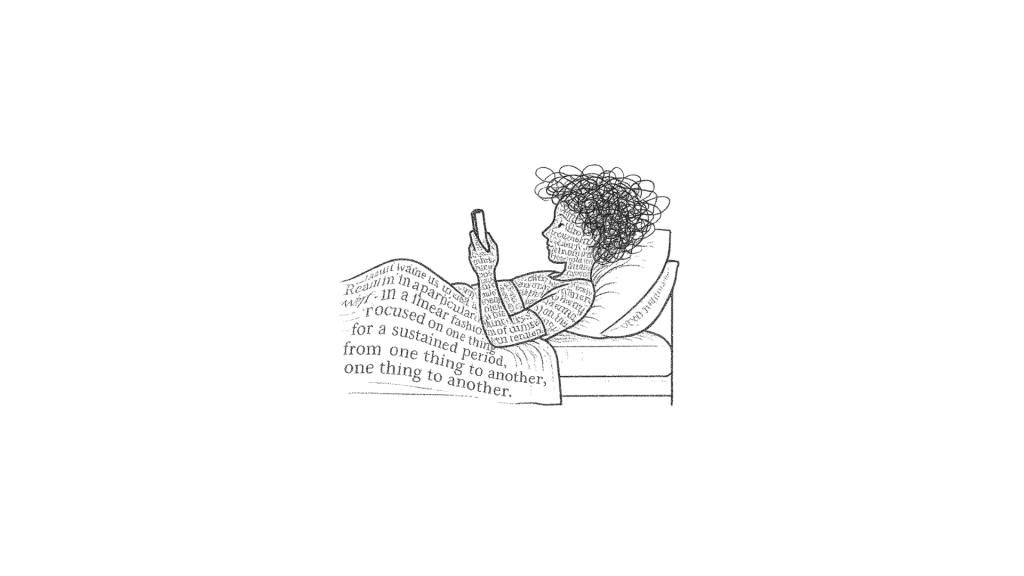
“Reading books trains us to read in a particular way – in a linear fashion, focused on one thing for a sustained period. Reading from screens, she has discovered, trains us to read in a different way – in a manic skip and jump from one thing to another” Johann Hari, Stolen Focus (Chapter 4)
From the moment the internet was first introduced and began making waves, introducing a new generation of technological advancement, we started facing screen inferiority. Think back to your childhood. If you’re like me, you probably remember growing up with picture books, then graduating to hundred-page novels, feeling a rush of excitement at the thought of finishing a 500-page book. So much so that you’d stay up past your bedtime with a book light clipped to the cover, turning each page in anticipation.
But now? That excitement is gone and in its place is boredom. And yet, what’s so bad about boredom, especially when we can just scroll endlessly and find something new to watch?
According to an article published by CNN titled “The boredom scroll on socials may be making your problem worse, study says,” this constant scrolling is actually making things worse. “This is concerning because boredom is linked to negative mental health, learning, and behavioral outcomes, such as depressive symptoms, poorer academic grades, and even sadistic aggression” (Madeline Holcombe, CNN). As a society, we’re always bored, which is exactly why we’re always scrolling. It’s become a way to distract ourselves, to fill time with quick-hit videos that might catch our attention for thirty seconds.
But how do we get out of this loop? How do we break free from screen inferiority?
An article from The Guardian offers an interesting perspective on a possible way forward, “What counted was the feeling of immersion and mastery. “The best moments,” he later wrote in his book Flow: The Psychology of Happiness, “usually occur when a person’s body or mind is stretched to its limits in a voluntary effort to accomplish something difficult and worthwhile” (David Robson).
Instead of laying in bed and scrolling, we should be challenging ourselves, engaging both our body and mind in something that requires focus, effort, and purpose. Of course, that’s easier said than done. I love streaming my favorite shows on Netflix just as much as anyone, but trust me when I say it makes a real difference in how you feel and how well you can concentrate.
Honestly, I think it would be fascinating to see what would happen if the entire world did a five-day digital detox. It’s something I’ll be trying soon in an effort to reset my own attention span. Hopefully, it helps me rebuild more meaningful hobbies and connections with the people around me, instead of staying stuck in bed, endlessly scrolling through the internet.
Sincerely,
(Hopefully) A recovering scroller
 DEAR SERIF
Leave a comment