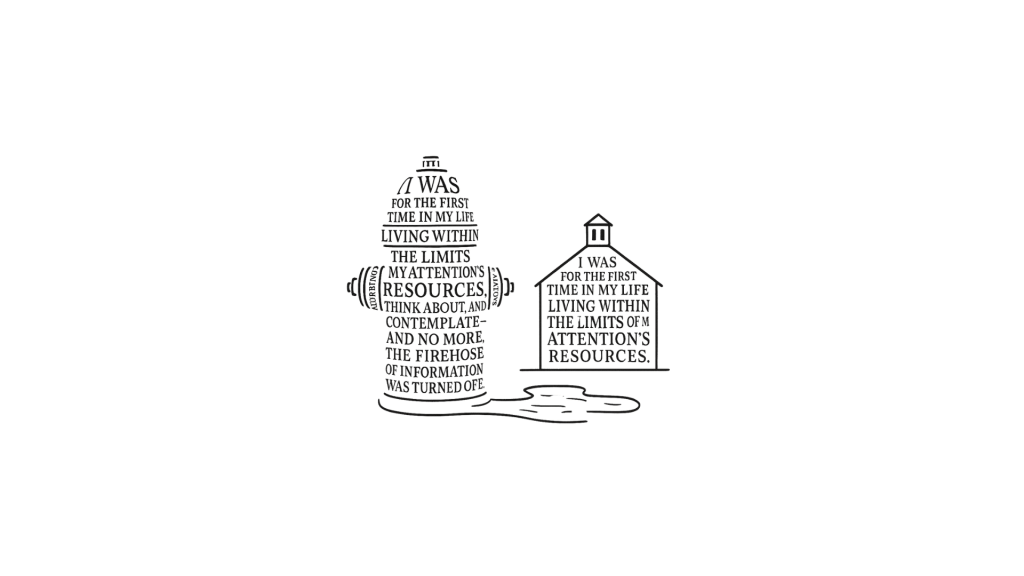
Dear Firehose,
Guess what I discovered today? Similar to you, many of our brains act exactly like you on a daily basis. As if there’s a burning fire created in our minds, one that longs for information, which is put out by an extreme pressure of said information from many different sources. But at what cost?
Depth.
“Depth takes time. And depth takes reflection. If you have to keep up with everything and send emails all the time, there’s no time to reach depth. Depth connected to your work in relationships also takes time. It takes energy. It takes long timespans. And it takes commitment” — Johann Hari, Stolen Focus (Chapter 1)
It’s become a frequent topic on how much the newer generations’ attention spans have decreased, especially following the rise of social media platforms like TikTok, Instagram, and X (formerly known as Twitter). So much so that according to The Oxford Blue, “…nearly 50% of users surveyed by TikTok said that videos longer than a minute long were stressful” (Jui Zaveri). With another study mentioning that “Hashtag peaks become increasingly steep and frequent” (Philipp Lorenz-Spreen, Bjarke Mørch Mønsted, Philipp Hövel, Sune Lehmann).
Just with social media alone, we have no depth. No real connection to what we’re actually looking at and viewing. But this makes it seem as though social media alone is the problem. And I blame you for this firehose. Not social media. Not the internet. Just you.
But why?
One of Hari’s friends, Ben Stewart, conducted a study where he “started analysing data from the 1880s, and it showed that every decade since, the way we experience the world has been getting faster, and we have been focusing on any one topic less and less” (Hari, The Stolen Focus Chapter 1).
Although social media and the internet have become extremely popular and used worldwide, it’s just another method to get to you. The firehose of information. Hari even mentions previously that Stewart’s study revealed how people were moving from topic to topic within different books during the 1800s, proving that it’s just another tool to access the firehose.
So now I ask of you: How can we turn off this firehose?
Well, I began my process with The New York Times, who published an experiment, allowing its readers to test their depth, inspired by a Harvard professor who made their students stare at a painting for three hours. Luckily, for me, this was only ten minutes. While trying this out I discovered that I honestly don’t take much time out to actually reflect. Once I sat down and took the time to truly take in this painting for ten minutes, it was honestly pretty enjoyable and allowed me to relax, taking in all the details of what I was seeing.
Firehose, although you can be helpful at feeding us tons of information, sometimes it’s better to turn. You off completely. Only in that way can we truly take time out to sip water at a comfortable pace, as Johann Hari says.
Sincerely,
Someone who’s trying to sip water at their own pace
 DEAR SERIF
Leave a comment